
Short UNTITLEDS
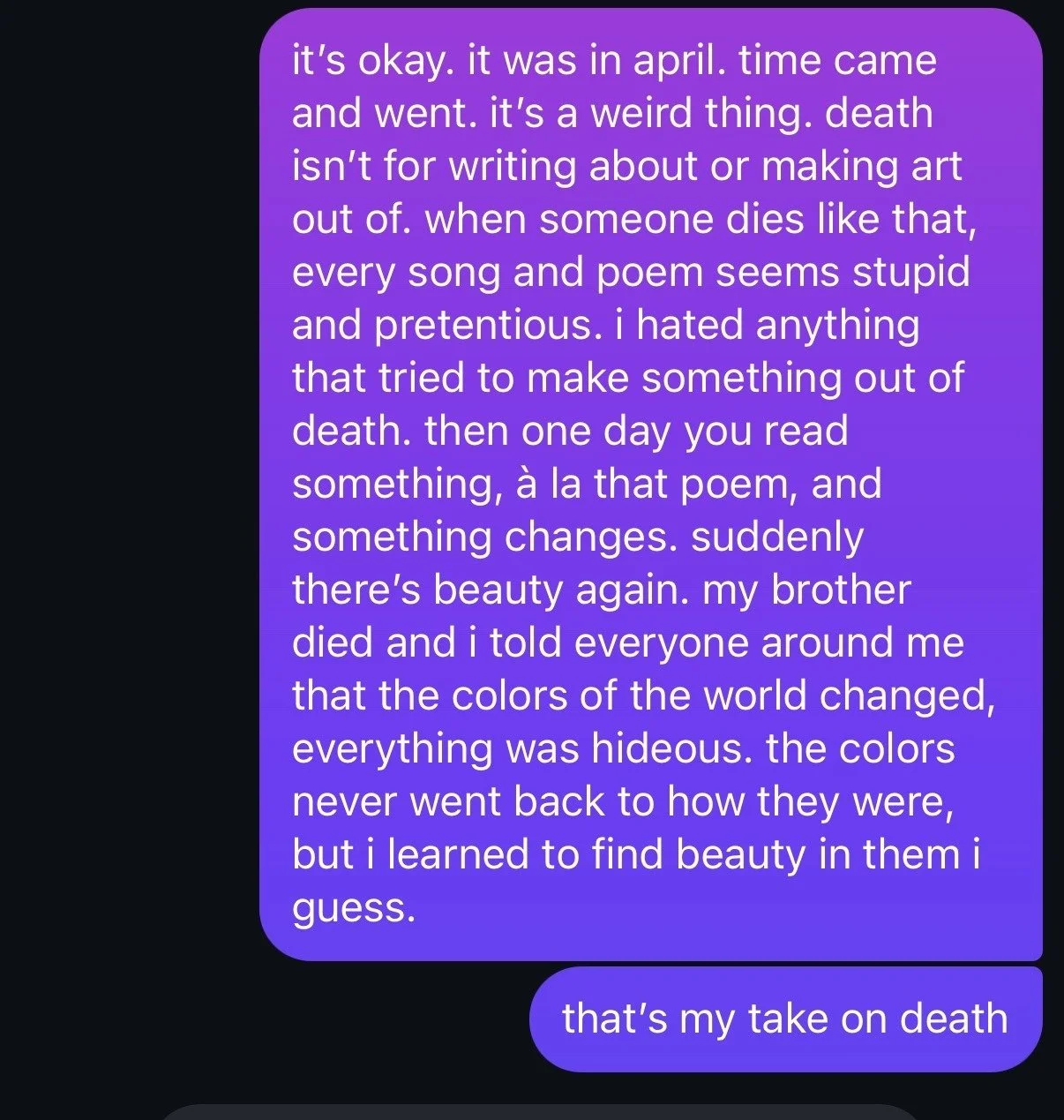
my brother died on a sunday,
the day after i went to work.
his funeral was on a sunday,
the day after i went to work.
my life is superseded by labor
i think marx spoke of that
idk
i should’ve been able to grieve for weeks.
i think i’ll grieve for years.
between my ramen
between my rent
between my work.
through black shades and under flashing lights,
no one can tell if you look beat, tired, or ill.
halfway through the night i meet someone,
we hit it off.
we are mostly joined together by 1 thing:
a common vice.
a love for bathroom stalls and dollar bills
as the night closes, we end up at some 24-hour restaurant.
doesn’t matter which one,
we both tell the other that we aren’t all that hungry.
In that booth, we look towards the other.
under these harsh lights,
you can see just how beat we are.
tired, pale, thin.
we don’t care.
these nights are all we have,
and we wouldn’t want to ruin it.
Spectacle is not power
Political assassination runs through all of history, from the Ides of March to Sarajevo, and it hasn’t stopped. But, ask what it actually won and the answer you will find is lacking, to say the least. Killings change direct, temporary events. They rarely deliver systematic change.
I don’t want to celebrate Mangione. It isn’t sympathy for the powerful. I shed no tears for Brian Thompson and none for the industry he ran. And I don’t think all political violence is the same thing. I object because this kind of act can’t produce meaningful progress towards socialism, and because it contradicts the oldest idea of leftist values: the working class has to free itself.
Mangione has since pleaded guilty in federal court to stalking resulting in Thompson’s death, telling the judge he shot him. In court, he said he acted after years of severe pain from a broken back and fights with the health insurance system. He went through real, justified anger. What he did, however, was personal revenge, not political activism that leftists should champion.
Positions outlast the people in them
Capitalism isn’t held up by a few cruel men. It’s held up by private ownership, wage labor, and the learned compulsion to accumulate wealth. These relations produce these capitalists the way bakeries produce bread; production will only stop when the bakers, the workers, make it stop.
We see this when looking at UnitedHealthcare. Thompson died, and the company kept running. Private insurance still stands between workers and their doctors. The man was removed and the machinery barely stuttered.
What the public did with the moment
The strongest reply to what I am putting forth is that the killing mattered anyway. It dragged claim denials into every kitchen conversation in America, and no strike ever did that overnight. I’ll concede the attention was real. The polling shows it. In a NORC survey, 69% said claim denials bore real responsibility for the killing, and 67% said the same of insurer profits.
But look at the rest of the numbers. In the same survey, 78% said the shooter bore a great deal or a moderate amount of responsibility. In an Emerson poll, 68% called the killing unacceptable and 17% called it acceptable, though when looking at voters under 30, about four in ten found it acceptable. Most Americans were, rightfully, enraged at the insurers and still unwilling to endorse the act. The anger was already there, and it had been for decades. Killing that man didn’t create it. It needed a structure to go latch onto, and the killing didn’t build one.
So ask what the attention bought. I can point to results. UnitedHealth’s stock fell, executives hired private security, and the company pulled leadership photos from its website. I can’t point to a group of workers organized or a law passed. All we got from Luigi was a better-guarded executive class.
It is not either/or, but it is a trade
A careful critic will say that broad analysis and individual acts aren’t mutually exclusive, and logically that’s true. We don’t have to choose between understanding capitalism and shooting a CEO. But movements have limited time and limited trust that is ever fleeting. We should judge our tactics the same way scientists judge their methods. We must judge our methods on whether they build organization and structure within the working class.
In regards to assassination, it does damage. Most of the public rejected the act, so a left that cheers the murder alienates itself from a majority that already hears “communist” and instantly thinks, “violent.” The state also gets to choose their response. Within days, the NYPD circulated an intelligence report that, according to journalist Ken Klippenstein, also flagged ordinary people who voiced sympathy as suspects. Repression doesn’t need our help, but we shouldn’t give it a precedent to hover over us.
We have run this experiment before
In 1881, the revolutionaries of Narodnaya Volya killed Tsar Alexander II after repeated attempts. They expected the regime to crack. It didn’t. His son took the throne, the police state tightened, and the organization was crushed. Lenin’s older brother was hanged in 1887 for a plot against the next tsar. The Russian Marxists who came after learned from this. The question wasn’t whether the tsar deserved to die. It was how workers would change the system in a way the regime couldn’t shoot out of existence.
Trotsky made the same point in Why Marxists Oppose Individual Terrorism. Kill a factory owner and another one takes the job. If the workers walk out together, the factory stops. The difference isn’t just that one is more effective. Capitalism can be viewed as a sort of factory. It doesn’t matter who dies, as long as the workers continue to produce for the factory, it will continue to run and fill the void of ownership. If the workers attempt to organize they, learn to bargain, to trust each other, and to see that what hurts them is a system and not a bad boss. A strike can lose, and many do. But losers can regroup and try again. An assassination leaves everyone else watching hoping for another political adventurist to eventually come and save the day.
Anger needs somewhere to go
That is the heart of it. The assassin acts, and the proletariat is suddenly an audience. A political environment built on admiration for the person who pulled the trigger teaches people that history is made by exceptional individuals. We should be teaching the opposite; there is no hero coming to save the day, we must create change on our own. Che, Lenin, Mao; these people weren’t heroes that saved the day. They were men who organized alongside others to fight to liberate themselves as a collective.
Go back to those poll results. The people are enraged at an industry that profits when it denies them proper care, and they are entirely justified to be, but that is only the emotional side of the contradiction that is a social necessity being run for private profit. Our job is not to point that anger at a target for revenge, but to help educate the working class so they can see the contradictions of capitalism and organize to resolve it themselves: a union drive, a tenants’ association, a campaign for universal coverage, a picket line, an armed rebellion. Those are slower and less cinematic. But they have shown that they can win things, and they lay the groundwork for the people who will go on to win more.
Celebrating Mangione feels good, and that feeling is the problem. We trade organizing for spectacle and political education for hero worship, and then the system is still there.
I’m not asking anyone to defend the people who exploit our illnesses and health. I’m asking us to want more than a moment of revenge. Capitalism will end when the workers who pump its blood refuse to do so anymore, and that is only achievable by a proletariat acting together, not a lone gunman.
Sources used and further reading
“41% of Young Voters Say UnitedHealthcare CEO Killing ‘Acceptable’: Poll.” Axios, 17 Dec. 2024, www.axios.com/2024/12/17/united-healthcare-ceo-killing-poll.
“Most Americans Think Insurance Industry Bears Some Blame for CEO Killing.” Axios, 27 Dec. 2024, www.axios.com/2024/12/27/brian-thompson-killing-responsibility-survey-healthcare-insurance.
“Luigi Mangione Pleads Guilty to Federal Stalking Charges in the Killing of UnitedHealthcare CEO.” WTTW News, 14 Aug. 2026, news.wttw.com/2026/08/14/luigi-mangione-pleads-guilty-federal-stalking-charges-killing-unitedhealthcare-ceo.
“Luigi Mangione Pleads Guilty to Federal Stalking Charges and Admits Shooting UnitedHealthcare CEO.” JURIST, Aug. 2026, www.jurist.org/news/?p=318175.
“Luigi Mangione Court Update: UnitedHealthcare Murder Case.” Newsweek, 2026, newsweek.com/luigi-mangione-court-update-united-healthcare-murder-case-12067422.
“Nearly 7 in 10 Americans Say Insurance Industry Is to Blame in UHC CEO Killing.” Truthout, truthout.org/articles/nearly-7-in-10-americans-say-insurance-industry-is-to-blame-in-uhc-ceo-killing.
“Revolutionary Adventurism.” Iskra, nos. 23-24, 1 Aug. and 1 Sept. 1902. Lenin Collected Works, vol. 6, translated by Clemens Dutt and Julius Katzer, Progress Publishers, 1964, pp. 186-207. Marxists Internet Archive, www.marxists.org/archive/lenin/works/1902/sep/01.htm. Accessed 28 Oct. 2026.
“Where to Begin?” Iskra, no. 4, May 1901. Lenin Collected Works, vol. 5, translated by Joe Fineberg and George Hanna, edited by Victor Jerome, Foreign Languages Publishing House, 1961, pp. 13-24. Marxists Internet Archive, www.marxists.org/archive/lenin/works/1901/may/04.htm. Accessed 28 Oct. 2026.
“Why Marxists Oppose Individual Terrorism.” Der Kampf, Nov. 1911. Marxists Internet Archive, www.marxists.org/archive/trotsky/1911/11/tia09.htm. Accessed 28 Oct. 2026.